TOUR ORDER Piercing Tools Jewelry Index © 2001  Unimax


Measurements and Gauge    © 2001  Unimax
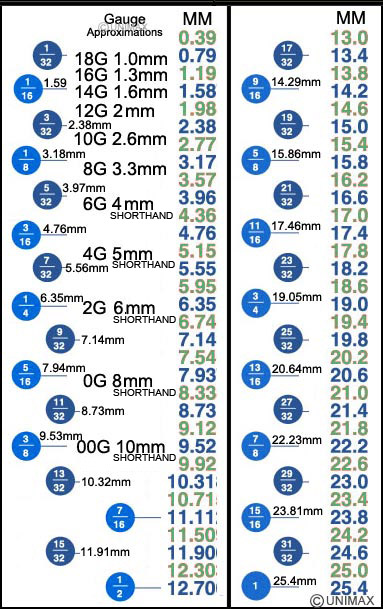
mm gauge inch
0.0912mm 19G .0359
1.024mm 18g .0403
1.15mm 17G .0453
1.291mm 16G .0508
1.628mm 14G .0641
1.828mm 13G .072
2.053mm 12G .0808
2.305mm 11G .0907
2.588mm 10G .1019
3.264mm 8G 1/8" (.1285)
3.665mm 7G .1443
4.115mm 6G 5/32" (1.62)
4.621mm 5G .1819
5.189mm 4G 3/16" (.2043)
5.827mm 3G .2294
6.544mm 2G 7/32" (.2576)
7.348mm 1G 1/4" (.2893)
8.251mm 0G 5/16" (.3249)
9mm    
10mm 00G 3/8"
11mm    
12mm   15/32"
13mm   1/2"
14mm   9/16"
15mm    
16mm   5/8"
17mm    
18mm    
19mm   3/4
20mm    
21mm    
22mm   7/8 (22.5mm)
26mm   1"
The gauge sizes of American Jewelry are the result of availability of product rather than a pre thought-out scheme of what would be suitable for piercing. We use even numbered gauge sizes (14-12-10-8, etc.) because odd numbered gauge sizes (13-11-9, etc.) are not normally used in wire applications so not generally available for purchase. For jewelry manufacturing what was available became the sizes used rather than what made sense for piercing jewelry.
AWG = B&S,   One "mil" = 1/1000 of an inch
Historically the US has used the American Wire Gauge (AWG) system, also known as Brown & Sharpe (B&S) Gauge system which is based on the division of an inch into 1000 units (thousands of an inch).  The division of the inch (a standard unit of measurement in US) is required because very small sizes need to be measured and calculated with accuracy and a base of 10 is much easier to calculate with than a base of 12.  A shorthand unit is used to refer to "one one thousand of an inch" (a mouthful) and is called a "mil."  Use of this term is similar to other very familiar terms; like foot, acre and pound.  It is easier to talk, write and think about 2 "miles" than to calculate and use how many feet this would be once you approach larger numbers. Consider the difficulty of measuring gas usage expressed in feet or inches.  Because calculations in electronics deal with numbers that can be 18 digits long and more, it is much easier to use smaller representational units and limit the number to three digits followed by the "shorthand" unit unless greater accuracy is needed.
In AWG the bigger (larger) the number, 
the smaller the size.
In the AWG system the larger the number, the smaller the size.  For example, a # 2 wire (2 Gauge) is nearly as large as a pencil. A # 44 wire is about the thickness of a human hair.  A 22 gauge wire can be used for electrical circuits; 16 and 18 gauges are common lamp cord sizes; and 14 gauge is the smallest size permissible for permanent wire installation.
Wires larger than 0-gauge are labeled 00 (2/0-twice the cm of 0), 000 (3/0-three times the cm of 0) and 0000 (4/0-four times the cm of 0).  Larger than this they are classified by their actual cross-sectional area (cm = "circular mil").
Looking at your gauge wheel the gauge size or number appears on one side, e.g. 14G. On the other size is the corresponding size in thousands of an inch, .064", and is 64 thousands of an inch or in shorthand speak: 64 mils.
The European system is Metric, based on dividing a unit of length into divisions of 10.  It is clear to see this would be an advantage for easy calculation.  The Metric System will be the universal standard and we should convert as soon as possible not only because it is easier mathematically but because it would serve our jewelry sizes more logically.  Our industry is becoming mature and requires re-evaluation and systemization based on what is good for piercing not what is just available.  Our efforts at Unimax have been focused on providing the leading edge of thinking and promotion of the science of piercing.